As an Amazon Associate, we earn from qualifying purchases. Some links on this site are affiliate links at no extra cost to you. Our recommendations are based on thorough research and editorial judgment.


The Science of Flame Control and Heat Distribution

Understanding flame control and heat distribution helps us manage fire effectively. Here’s a quick overview of the science behind it:
- Heat Transfer Mechanisms: Conduction, convection, and radiation are key processes.
- Conduction: Transfers heat through contact, affecting nearby materials.
- Convection: Moves hot air and gases, spreading heat quickly.
- Radiation: Transmits energy from surfaces, influencing fire dynamics.
You may be interested



Each element plays a crucial role in fire safety and behavior. If we keep exploring, we’ll discover more about these essential concepts.
Key Takeaways
- Effective flame control relies on understanding heat transfer mechanisms, including conduction, convection, and thermal radiation.
- Conduction transfers heat through materials, crucial for predicting fire behavior and using fire-resistant materials for safety.
- Convection aids in flame spread by moving hot gases, with factors like airflow affecting heat distribution.
- Thermal radiation can preheat distant fuels, increasing fire intensity, particularly in medium to large fires.
- Utilizing appropriate materials and barriers enhances flame control and protects structures from heat distribution risks.
Understanding Heat Transfer Mechanisms
When we talk about heat transfer mechanisms, it’s essential to recognize the different ways heat moves and influences fire behavior. Here are the primary methods we focus on:
- Conduction: This is where heat moves through direct contact. In wildfires, materials close to each other, like dense fuels, enable effective heat diffusion.
- Convection: Here, heat travels via fluid movement, usually airborne, creating air circulation that can quickly spread fire.
Understanding these principles of thermal conductivity helps us predict fire behavior. It’s important for safety in urban areas next to wildlands. Fire modeling software incorporates these mechanisms to analyze fire spread and intensity. Also, fire investigators rely on these methods to determine ignition points during forensic analysis. Knowing how heat transfers isn’t just academic; it’s life-saving. Similar to how multiple layers of insulation in coolers prevent heat transfer to maintain cold temperatures, effective fire barriers utilize insulation principles to slow heat diffusion and contain flames.
The Role of Thermal Radiation in Fire Dynamics

Understanding heat transfer mechanisms sets the stage for recognizing the powerful role thermal radiation plays in fire dynamics. Here’s what we need to know:
- Energy Transmission: Thermal radiation transmits energy through electromagnetic waves from heated surfaces in all directions.
- Influential Factors: The Stefan-Boltzmann law tells us that the energy radiated increases with the fourth power of temperature.
- Fire Impact: In medium to large fires, thermal radiation often dominates heat transfer, affecting flame spread and intensity.
- Ignition Promotion: It can preheat distant fuels, accelerating fire growth and increasing the risk of flashover.
- Modeling Techniques: Accurate predictions of fire behavior require understanding radiation exchange between surfaces and gases.
- Material Protection: Just as waterproof ratings protect camping equipment from moisture, fire-resistant materials with proper thermal barriers shield structures from intense radiant heat exposure.
Conduction and Its Influence on Flame Propagation

Conduction serves as an essential method of heat transfer, especially in the context of flame propagation. Here’s how it works:
- Conduction dynamics involve particles in solid materials vibrating and transferring heat to nearby areas.
- The material properties greatly influence this process; for instance, some materials conduct heat better than others.
- A strong temperature gradient is necessary for efficient conduction, which can affect how quickly a flame spreads.
We also need to take into account that thicker or denser materials can slow conduction but may increase overall heat transfer over time. Understanding these principles helps us devise better fire safety measures. By selecting appropriate materials, we can effectively control flame spread and create safer environments, both at home and in industrial settings. In camping applications, materials like aluminum alloy and copper are chosen for fuel system components due to their superior heat conduction properties and durability.
Convective Heat Transfer and Flame Behavior

Flame behavior isn’t only influenced by conduction; it’s equally guided by convective heat transfer. Here’s how it works:
- Heat Movement: Hot gases rise, transferring heat away from the flame. This action heats surrounding fuels, which helps ignition.
- Convection Coefficients: The rate varies based on the flame temperature and airflow. Higher coefficients mean better heat transfer.
- Types of Convection: There are two main types:
- Natural Convection: Driven by heat rising due to buoyancy.
- Forced Convection: Created by winds or air movement.
Understanding these principles is essential. Convective heat transfer not only influences flame spread but also determines flame intensity and behavior. By mastering these concepts, we can better manage fire dynamics and safety. In practical applications like wood burning stoves, air vents play a crucial role in controlling both natural and forced convection to optimize combustion efficiency and heat output.
Heat Transfer Considerations in Structural Fire Safety
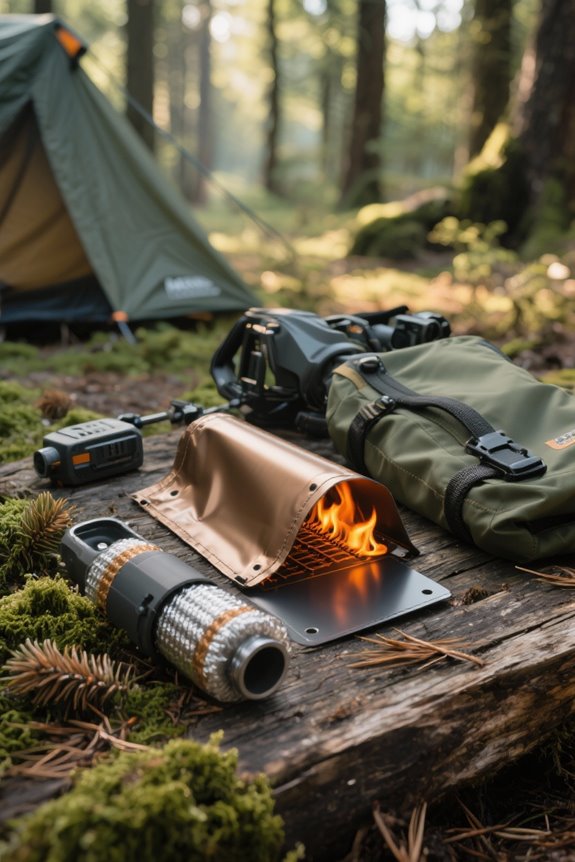
When we think about fire safety in structures, several heat transfer mechanisms stand out as essential to preventing disaster. Understanding these helps facilitate compliance with fire safety regulations.
- Conduction: Transfers heat directly to materials nearby, increasing their vulnerability.
- Convection: Moves heat through gases, spreading it quickly across an area.
- Radiation: Dominates in large fires, igniting adjacent structures through radiant heat.
To enhance structural resilience, we also need to take into account the following:
- Fire-Resistant Materials: Choosing appropriate siding and roofing can slow fire spread.
- Effective Flame Barriers: These interrupt radiant heat transfer, protecting structures.
Lantern components like heat-resistant glass globes demonstrate how proper material selection can withstand high temperatures while maintaining functionality and protecting critical elements from thermal damage.
Recommended Products

❤️🏕️Attention buyers! Our new design this year allows you to own a high-quality gazebo at a lower cost. That's right! Our new entry-level gazebo offers top-notch quality without breaking the bank. Don't miss out on this opportunity to enjoy the great outdoors without overspending. Get your hands on our new gazebo design today!

Premium Travertine Stone – Crafted from authentic Scabos travertine with a splitface finish, combining natural beauty and long-lasting durability.

Ample Leisurely Space- With dimensions of 145.71"(L) x 95.47"(W) x 93.07"(H), Domi lean-to gazebo offers a luxurious 96 square feet of room to unwind and enjoy the outdoors. From hosting a barbecue with friends and family to reading your favorite book in a sun-drenched afternoon, you can get endless creativity and happiness.
Applications of Heat Transfer Science in Fire Management
Understanding heat transfer is a game-changer in fire management. By applying heat transfer science, we can enhance fire detection, suppression strategies, and WUI protection. Here’s how:
- Early Detection: Advances in sensor technologies allow us to spot radiant heat increases before flames appear, enabling quicker responses.
- Suppression: Effective suppression strategies utilize water cooling to reduce heat transfer, slowing fire spread considerably.
- WUI Protection: In the Wildland-Urban Interface, understanding how heat travels through windows helps us minimize ignition risks. Specific building codes and materials can mitigate the danger.
Incorporating these insights equips us with tools to improve safety and response times, ultimately aiding in protecting lives and property. By working with heat dynamics, we can take fire management to the next level. The principles of heat retention used in cast iron cookware demonstrate how materials can be engineered to manage thermal energy effectively, a concept applicable to fire-resistant building materials.
Recommended Products

RELIABLE 24/7 VISION - Infrared/Thermal imaging reveals humans and animals in complete darkness or glaring light, offering reliable detection at any time of day.

Dual fuel design runs on both gasoline (8000 surge watts, 6500 rated watts) and propane (7200 surge watts, 5850 rated watts)

EVERYTHING YOU NEED. DAY ONE. — Over $240 in essentials included so your Defend works right out of the box. You get the camera, the Defend solar panel, the rechargeable battery, a Lexar 32GB SD card, and a Field Boys cleaning cloth. No second Amazon order. No missing parts. Mount it and you're running.
Frequently Asked Questions
How Do Weather Conditions Affect Fire Spread and Heat Transfer?
Weather patterns notably influence fire behavior. We’ve seen how strong winds, high temperatures, and low humidity create conditions for rapid fire spread, while moisture and cool temperatures can help control it. Understanding this is essential.
What Materials Are Most Effective for Fire Insulation?
When it comes to fire resistant materials, we find that rockwool and mineral wool excel in insulation effectiveness, maintaining structural integrity at high temperatures. Fiberglass also provides solid performance for fire safety applications.
How Can Smoke Movement Impact Heat Distribution During a Fire?
In the dance of smoke dynamics, we see heat gradients twist and swirl, determining fire’s reach. As hot gases rise and cooler air flows beneath, they guide heat distribution, shaping the room’s fiery temperament.
What Role Do Firebreaks Play in Managing Heat Transfer?
Firebreaks enhance firebreak effectiveness by interrupting heat transfer. They limit conduction, radiant, and convective heat pathways, helping protect unburned areas and structures from fire spread, hence serving as essential tools in fire management strategies.
How Do Humans Perceive Heat From Fire Radiatively?
Did you know humans can feel thermal radiation from fire at distances exceeding 20 feet? Our sensory response to heat is essential; it activates instinctual reactions, helping us react promptly to the dangers of fire.


