As an Amazon Associate, we earn from qualifying purchases. Some links on this site are affiliate links at no extra cost to you. Our recommendations are based on thorough research and editorial judgment.

How to Signal for Help in Emergency Situations

In emergency situations, signaling for help can be lifesaving. We can use various methods, including:
- Visual Signals: Flares, smoke signals, and reflective materials.
- Auditory Signals: Whistles or alarms, using three distinct blasts to indicate distress.
- Electronic Signals: PLBs or two-way radios for quick communication.
You may be interested



It’s essential to have a well-prepared signal kit with essential items like whistles and flares. Knowing these methods will enhance our chances of rescue, and we can explore more effective techniques next.
Key Takeaways
- Use three long blasts of a whistle or repeated signals to establish a clear distress call recognized universally.
- Utilize visual signals like flares, orange smoke, or reflective gear to attract attention, especially in low visibility.
- Deploy personal locator beacons (PLBs) or emergency position-indicating radio beacons (EPIRBs) for quick rescue alerts.
- Create large symbols like “X” on the ground for aerial visibility to guide rescuers to your location.
- Always keep a well-prepared emergency signal kit, including whistles, flares, and GPS, readily accessible.
Understanding Emergency Signals
When we’re faced with an emergency, understanding how to signal for help is essential. Proper emergency preparedness involves knowing various methods of communication. Here are some key signals we can use:
- Two-way radios, including CB and ham radios, allow real-time communication, making them invaluable in emergencies.
- Using whistles or banging on pipes in sets of three creates a loud, recognizable distress signal.
- Personal Locator Beacons (PLBs) send GPS-based alerts to responders, facilitating quick rescues.
- Smartphone apps that mimic sounds can serve when traditional methods aren’t feasible.
- For outdoor enthusiasts venturing into remote areas, carrying lightweight emergency equipment with features like built-in pumps or inflation mechanisms can ensure quick setup of shelter while awaiting rescue.
Types of Visual Signals
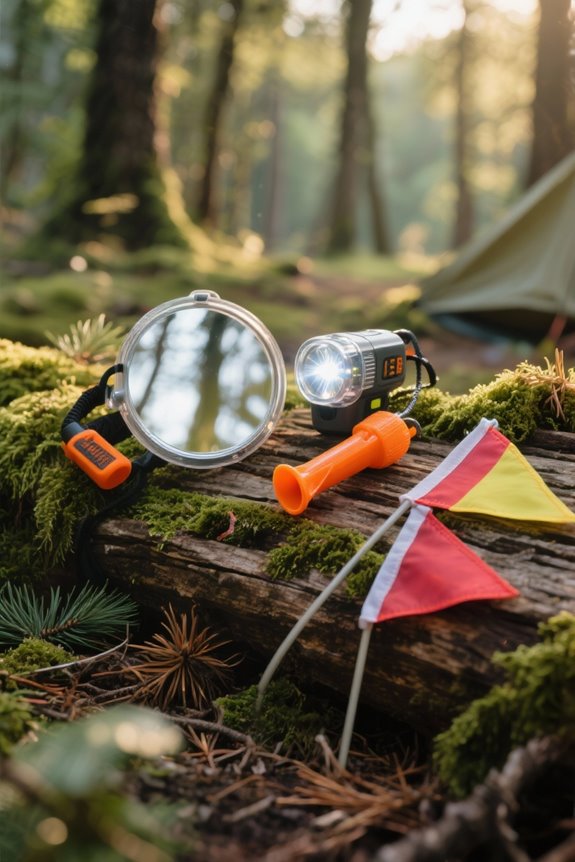
Visual signals are critical in emergencies, especially when we need to stand out against natural surroundings. Let’s explore some key visual signal types:
- Pyrotechnic Signals:
- Red handheld flares, parachute flares, and meteors work day and night.
- Orange smoke signals are for daytime use only and can attract attention quickly.
- Non-Pyrotechnic Alternatives:
- Orange distress flags and electric distress lights are reusable options.
- Electric lights last up to 60 hours without needing an expiration date, unlike flares.
Each type serves its purpose, allowing us to signal effectively based on light conditions. However, we must choose correctly and understand the regulations surrounding these signals to guarantee safety and compliance in emergencies. Proper usage can maximize our chances of a swift rescue. For enhanced visibility during nighttime emergencies, consider attaching reflective strips to your gear or clothing to help rescuers locate you more easily.
Recommended Products

US Coast Guard Approved: Legally replace your flares with a long-lasting, high-intensity LED 2-color SOS distress signal

All-In-One Safety Solution: A certified visual and audible distress signaling system combined with first aid, lighting, and tools for emergencies on the water

MADE TO LAST - Our life rings have a poly shell that is energy absorbent and has poly grab lines that contain UV stabilizers to enhance sunlight resistance for additional safety. These rings are for both commercial and recreational use
Effective Auditory Signals

While effective visual signals play a pivotal role in emergencies, auditory signals are just as important. To effectively signal for help, we can utilize various auditory methods:
- Whistles: Their loud, distinct sound cuts through noise.
- Alarm Design: Alarms should be distinguishable but don’t need to be overly loud.
- Feedback Mechanism: Incorporating auditory feedback improves our response time.
Remember, in noisy environments, the effectiveness of auditory signals can diminish. So, it’s wise to complement them with visual or tactile signals when needed.
Key Considerations:
- Use specific tones to convey urgency.
- Be aware of background noise interference.
- Design signals for clarity—this keeps us safe.
These strategies guarantee we communicate effectively during emergencies, allowing others to hear and respond quickly. When camping or hiking in remote areas, carrying lightweight emergency equipment like whistles ensures you can signal for help without adding unnecessary weight to your pack.
Recommended Products

UL1973 | UL9540A | CEC LISTED - Completed comprehensive testing by Intertek and has officially earned two key North American safety certifications.And has met the standards set by the California Energy Commission.The outstanding performance in design, electrical safety, and thermal runaway management,providing users with greater quality assurance.

Unmatched Comfort & Adjustability: Elevate your sleeping experience with our head (up to 75°) and foot (up to 45°) lift mechanism, allowing for perfect positioning. The unique headboard hugger ensures you stay close to your nightstand, while the additional head (pillow) tilting provides personalized comfort. Lumbar support ensures your spine is well-supported throughout the night.

Unmatched Comfort & Adjustability: Elevate your sleeping experience with our head (up to 75°) and foot (up to 45°) lift mechanism, allowing for perfect positioning. The additional head (pillow) tilting feature provides even more personalized comfort. Lumbar support ensures your spine is well-supported throughout the night.
Importance of Electronic Signals

In today’s world, electronic signals play an essential role in emergency situations, enhancing our ability to communicate quickly and reliably. Here are some electronic advantages we benefit from:
- Signal Reliability: Technologies like LoRaWAN guarantee effective communication even in crowded areas, overcoming many interferences.
- Robustness: Autonomous devices can operate in various weather conditions, assuring that our distress signals always get through.
- Real-time Monitoring: Continuous monitoring helps us stay alert, allowing for swift responses with minimal delay.
- Data-Driven Decisions: AI helps identify emergencies quickly, optimizing routes for emergency vehicles to respond faster.
- Durability Standards: Emergency signaling devices should meet safety standards similar to those required for outdoor equipment, ensuring they can withstand harsh conditions and function reliably when needed most.
Recommended Products

【Nationwide Walkie Talkie】Cellular POC ptt-walkie talkies technology for seamless unlimited range coverage.The 4g lte SIM card is pre-inserted for you.Just unbox,power on, and enjoy crystal clear instant rapid communication across California to New York,cities, states,and countries.FCC ID: 2BK59-M12


18000A Peak for Heavy-Duty Rescue The COSSIFTW YL300 delivers a massive 18000A peak current, providing the cranking power needed to start heavy-duty trucks, RVs, tractors, and boats with large-displacement diesel or gas engines. It effortlessly overcomes high compression ratios and cold-weather starting challenges. Fully compatible with all 12V vehicles, from motorcycles and ATVs to lawnmowers and snowmobiles.
Passive vs. Active Signals

When we find ourselves in emergency situations, understanding the differences between passive and active signals is essential for effective communication.
Passive Signaling
- Doesn’t need constant human effort.
- Visibility depends on pre-existing materials like debris or clothing.
- Great for conserving energy over time.
Active Signaling
- Requires immediate, ongoing efforts to catch attention.
- Examples include waving, using flashlights, or smoke.
- Excellent for urgent situations because it draws immediate focus.
- If you have a portable fire pit, creating smoke signals can be an effective active signaling method, especially since many modern designs like propane models produce controllable flames that can generate visible smoke when needed.
Daytime and Nighttime Signaling Methods
Effective signaling methods, whether during the day or at night, are essential for alerting rescuers to our location in emergencies. Here’s how we can effectively use visual and auditory signaling.
Daytime Visual Signaling:
- Signal mirrors: Reflect sunlight for long-distance flashes.
- Bright-colored smoke: Visible plumes in orange/red help teams spot us.
- Handheld flares: Good for day and night, but need clear weather.
Nighttime Signals:
- Red flares: Bright and recognized internationally.
- Electric distress lights: Flashing lights that last long without fire risk.
- Whistles: Sound can travel far, especially in quiet areas.
Combining visual and auditory signals improves our chances of being found. For extended outdoor emergencies, consider packing a 12-volt portable cooler to maintain essential supplies like medications and food at safe temperatures while awaiting rescue. Let’s stay prepared!
Best Practices for Distress Signals
To signal for help effectively, it’s fundamental to understand and implement best practices for distress signals. Here are key points to reflect on:
- Use Patterns: Three signals in a row are universally recognized. Distress signal examples include three whistles, flashes of light, or blasts on a horn.
- Maintain Visibility: High contrast is essential. Bright colors stand out against backgrounds like snow or trees.
- Audible Signals: Whistles travel farther than our voices. Use three long blasts with pauses between for effectiveness.
- Stationary Signs: Create large symbols, like X’s on the ground, to guarantee aerial visibility.
In our signal effectiveness analysis, consistency and clarity are critical. Practicing these signals prepares us for emergencies, increasing our chances of being rescued. When preparing for outdoor emergencies, consider packing lightweight portable equipment like compression sacks that can hold essential signaling devices without adding excessive weight to your gear.
International Standards for Emergency Signals
Understanding international standards for emergency signals is key for effective communication during crises. These standards, like the International Code of Signals and Annex IV of COLREGs, are essential for signaling accuracy in emergencies. Here’s what we should know:
- International Protocols: They provide a shared language, addressing language barriers in maritime risks.
- Signal Types: Signaling includes visual (flares), sound-based (horns), and electronic signals (radio).
- Distress Signals: “MAYDAY” and “PAN-PAN” are standardized voice calls for emergencies, repeated for emphasis.
Using these recognized signals guarantees clarity, speed, and coordination among responders. Remember, misusing these signals can lead to serious confusion. Visual signals can also include emergency lighting, which may utilize portable lantern stands that typically support weights ranging from 5 to 15 pounds and feature weather-resistant materials for outdoor use. Let’s commit to understanding and using these international standards when we’re in need.
Equipment for Signaling in Emergencies
When we find ourselves in an emergency, having the right equipment to signal for help can make all the difference. Here are some essential tools we should consider:
- EPIRBs: Great for maritime use, sending distress signals via satellite.
- PLBs: Portable alternatives that are lightweight and easy to carry.
- Flare types: Hand-held, parachute, and floating flares help provide visual signals.
- Strobe effectiveness: Bright lights are useful during low visibility.
- Signal mirror tips: Reflect sunlight to attract attention.
- Satellite communicators: For messaging and emergency alerts.
- Audible signaling: Whistles and dive horns can penetrate harsh conditions.
- Pocket flares: Compact options for intense light in emergencies.
- Rescue kits: Should be readily available for anyone venturing outdoors.
With the right gear, we increase our chances of being located quickly. Additionally, a shoulder strap cooler with waterproof materials can be valuable for carrying emergency supplies and maintaining hydration during extended outdoor situations.
Recommended Products

ResQLink View RLS Personal Locator Beacon | Features Return Link Service - Direct confirmation message sent back from Cospas Sarsat Satellite Network

RECHARGEABLE - WATERPROOF - MAGNETIC - TOUGH

1. Safer and ecologically better for our environment than flame style emergency road flares. No spark, open flame, fumes or toxic chemicals are produced when using the LED Road Flare. Small enough to keep in a saddle bag, tank bag, or even those small under seat storage spaces that most bikes have. The Safety Light has 9 flash patterns.
Signaling Techniques in Different Environments
In various settings, knowing the right signaling techniques can greatly enhance our chances of getting help when needed. Each environment presents unique signaling challenges, but we can maximize our signaling effectiveness with the right methods:
Visual Signals:
- Signal Mirrors: Use reflective light to attract attention.
- Flares: Ideal for day or night, marking locations effectively.
- Ground Markers: Create large symbols for aerial visibility.
Auditory Signals:
- Whistles: Three sharp blasts are universally recognized.
- Air Horns: Effective on water, signaling distress with clarity.
Electronic Signals:
- Cell Phones: Call or text emergency services.
- PLBs: Transmit distress signals globally.
For ground-to-air signaling, reflective pull loops on tent stakes can be repurposed to create visible markers that catch sunlight and increase your visibility to search aircraft.
Limitations of Various Signaling Methods
Signaling methods come with their own set of limitations, which can hinder our efforts to call for help in critical situations.
- Signal Reliability: Many devices face data inconsistency, affecting the accuracy of our signals.
- Communication Barriers: Some signals, like EPIRBs, send only distress signals, limiting our ability to share more information.
- User Error: Incorrect usage can cause missed opportunities for assistance.
- Environmental Factors: Weather can obstruct signal visibility, while technological failures may leave us without support.
- Underreporting: Lack of knowledge about reporting requirements means some incidents go uncommunicated.
These challenges remind us to always prepare and remain aware of the limitations we might face when signaling for help.
Preparing Your Signal Kit
Preparing our signal kit is essential for effective communication in emergency situations. A well-prepared kit includes several signal kit essentials:
- Handheld GPS units for exact location tracking.
- VS-17 panels for visual signaling.
- Emergency signal mirrors to reflect sunlight.
- High-decibel whistles for auditory signaling.
- Glowsticks for nighttime visibility.
We must guarantee proper maintenance too. Regularly check batteries in flashlights and replace expired items. Keep reflective surfaces shiny and mirrors clean. Store gear in waterproof containers, and review kit contents every few months. We can also add personal items like maps and emergency contacts for quick reference. By staying organized and prepared, we can increase our chances of effective signaling during emergencies.
Recommended Products

HUGE PORTABLE POWER: The WGen14500DF dual fuel generator is an ideal power source for jobsites and emergency backup of larger homes. Gas: 18,000 peak watts, 14,500 running watts; Propane: 16,000 peak watts, 13,000 running watts

GlobalFix V6 RLS EPIRB (Cat. 2) – FCC Approved, reliable emergency beacon for maritime safety, ensuring quick distress signaling in critical situations.

5000 Peak Watts and 3900 Rated Watts at Less Than 3% THD; Telescoping Handle; Gas Powered; Remote Start With Included Key Fob, Electric and Recoil Start
Training for Emergency Situations
Effective training for emergency situations is essential, especially since it helps us respond swiftly and efficiently when it matters most. Here’s how we can enhance our preparedness:
- Emergency Drills: Regular practice through drills keeps our skills sharp. These realistic scenarios help us learn how to react in real emergencies.
- Response Training: This involves understanding the protocols for various emergencies, enhancing our ability to provide critical instructions quickly.
- Technology Integration: Using communication platforms during training allows us to simulate real crisis conditions.
- Continuous Improvement: After each drill, we debrief to discuss what went well and what needs refining.
Legal Considerations in Using Distress Signals
Understanding the legal landscape surrounding distress signals is essential for anyone involved in maritime activities. We must adhere to specific regulations to guarantee safety and compliance. Here are key points to remember:
- Legal Requirements: Visual distress signals (VDS) are mandatory for boats in U.S. coastal waters and the Great Lakes.
- Approved Signals: Confirm signals are Coast Guard approved, serviceable, and accessible.
- Signal Validity: Pyrotechnic signals expire and must be replaced regularly.
- Penalties: Using distress signals in non-emergency situations can lead to severe legal penalties.
- Exceptions: Some small boats may be exempt from certain requirements.
Staying informed and compliant helps maintain safety while helping those in true need of assistance. Always remember, misuse can have serious repercussions.
Frequently Asked Questions
What Should I Do Before Signaling for Help?
Before signaling for help, we should assess the situation thoroughly and prioritize safety precautions. Making sure we’re in a visible location, gathering supplies, and staying safe are essential steps for effective communication.
How Do I Choose the Best Signal Type?
Choosing the best signal type isn’t rocket science; it’s just about matching signal types to our surroundings. We should consider visibility, reliability, and whether visual signals like flares or mirrors will actually grab attention.
Can I Signal for Help Without Any Equipment?
Yes, we can signal for help without equipment. Using body language signals alongside visual signals, like arranging rocks or waving clothing, can effectively attract attention. It’s all about creativity and being noticeable.
What if I’m Unable to Make Noise or Light?
When words fail, actions speak louder. If we can’t make noise or light, we can use silent signals, like visual cues—shapes or reflective materials—to grab attention and guide rescuers toward us.
How Can I Improve My Chances of Being Rescued?
To improve our chances of being rescued, we should master survival skills and utilize effective rescue techniques. Practicing signaling methods, staying calm, and understanding our environment can greatly increase our visibility and attract help.


